


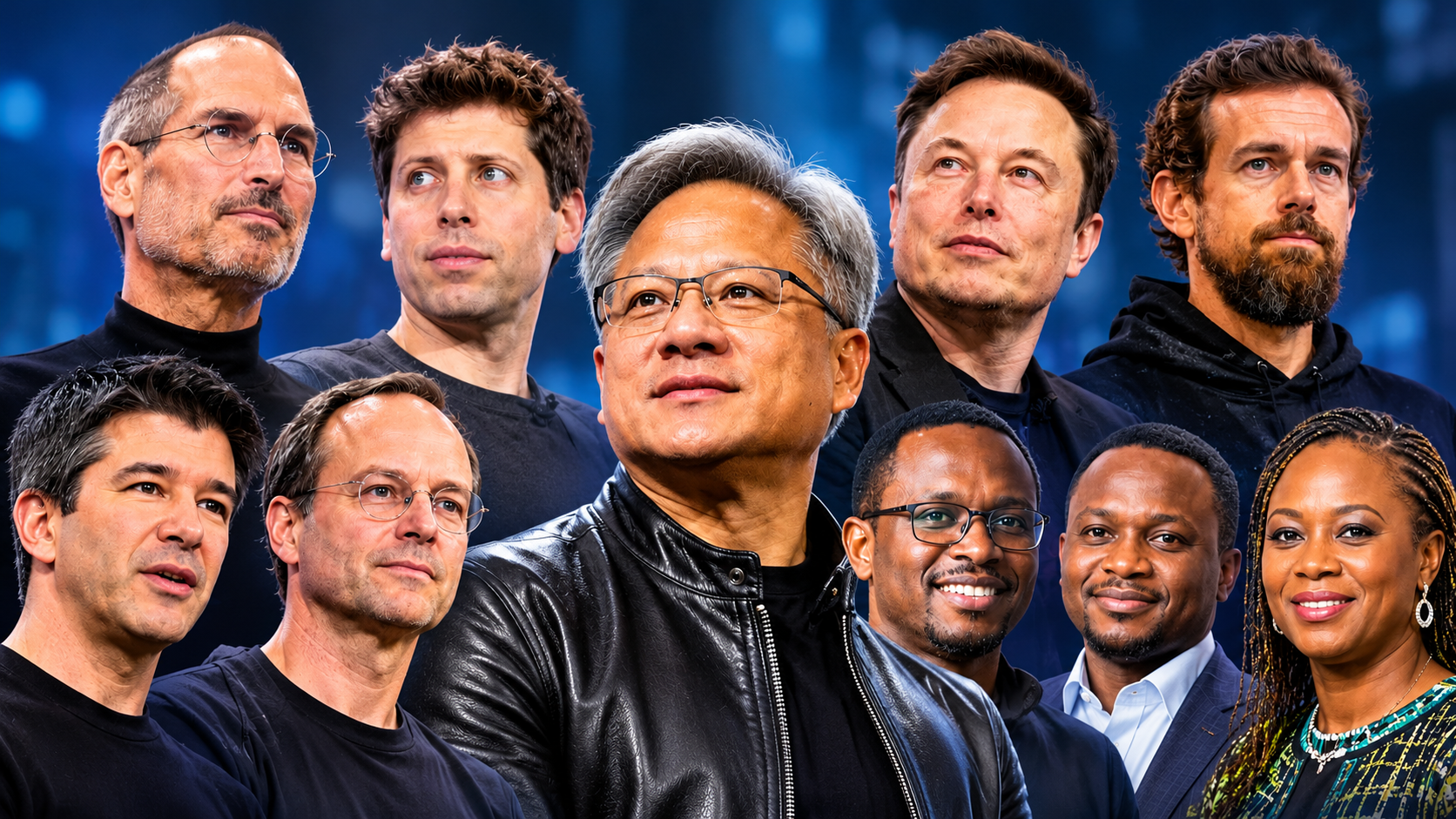
10 Tech Founders Who Lost Their Jobs at Companies They Built
From Steve Jobs and Elon Musk to Africa’s own startup founders, these stories show that building a company does not always guarantee control over its future.
There is perhaps no stranger experience in business than being pushed out of a company you helped create. You come up with the idea, convince people to believe in it, build the product, bring in investors and spend years turning an ambitious idea into a functioning business. Then, one day, you find yourself on the outside looking in.
It is a reality that has played out in some of the world’s biggest technology companies. Founders who were once the face of their businesses have found themselves at odds with boards, investors and fellow executives, sometimes losing the very positions they worked so hard to establish.
But losing the corner office does not always mean the end of the story. Some have returned to lead their companies again. Others have built entirely new businesses, while a few have watched their original creations move forward without them.
Nvidia’s Jensen Huang has brought the conversation back into focus following his dramatic departure and subsequent reinstatement as chief executive in November 2026. His experience joins a long list of founder exits that have raised questions about ownership, corporate governance and who ultimately gets to decide the future of a company.
Here are ten technology and business founders who experienced the difficult side of building a company.
1. Steve Jobs – Apple
The founder who returned to transform the company
Few founder departures are as famous as that of Steve Jobs from Apple.
In 1985, Jobs was pushed out of the operational leadership of the company he had co-founded with Steve Wozniak and Ronald Wayne. His relationship with then-chief executive John Sculley had deteriorated, with disagreements over Apple’s direction and management eventually culminating in a boardroom power struggle.
Jobs subsequently left Apple and established NeXT, a computer company focused on the education and business markets. He also acquired the computer graphics division that would become Pixar, which went on to produce some of the most successful animated films of its time.
Apple’s fortunes, meanwhile, began to weaken. By the mid-1990s, the company was struggling with declining sales, an increasingly complicated product range and leadership uncertainty.
In 1996, Apple acquired NeXT in a deal worth approximately $400 million, bringing Jobs back into the company. He initially returned as an adviser before becoming interim CEO in 1997.
What followed was one of the most remarkable corporate turnarounds in business history. Jobs oversaw the introduction of the iMac, iPod, iPhone and iPad, transforming Apple into one of the world’s most valuable technology companies.
His story remains the ultimate reminder that being removed from a company does not necessarily mean the end of a founder’s influence.
2. Sam Altman – OpenAI
The boardroom decision that triggered an employee revolt
In November 2023, Sam Altman was abruptly removed as chief executive of OpenAI, the artificial intelligence company behind ChatGPT.
The board announced that Altman had not been consistently candid in his communications with directors, making it difficult for them to fulfil their oversight responsibilities. It said it had lost confidence in his ability to lead the company.
The announcement sent shockwaves through the technology industry.
OpenAI employees rallied behind Altman, with hundreds threatening to resign unless the board reversed its decision. Microsoft, a major investor and commercial partner, also stepped in, offering Altman a role leading a new advanced AI research team.
The situation quickly became a test of how much influence a company’s board could exercise when its employees, investors and commercial partners appeared to favour a different leader.
Within days, the board agreed to his return. Altman was reinstated as CEO under a reconstituted board, bringing one of the most dramatic leadership reversals in Silicon Valley to a close.
The episode also exposed the unusual governance structure of OpenAI, which was established as a nonprofit organisation before creating a commercial arm to support its growing ambitions.
For Altman, the brief departure did little to diminish his influence in the artificial intelligence industry. If anything, it demonstrated how central a founder can become to the company they lead.
3. Jack Dorsey – Twitter
Pushed out once, welcomed back years later
Jack Dorsey helped establish Twitter in 2006, alongside Biz Stone, Evan Williams and Noah Glass. He was the company’s first CEO and played a central role in developing the platform that would become one of the world’s most influential social media networks.
However, his first stint at the helm was short-lived.
In 2008, Dorsey was pushed out as CEO, with fellow co-founder Evan Williams taking over. Dorsey moved into the role of chairman, although his relationship with the company remained an important part of its leadership story.
He did not disappear from the technology industry. Dorsey went on to build Square, the financial technology company that later became Block, developing payment tools for businesses and consumers.
In 2015, he returned to Twitter as CEO after Dick Costolo stepped down.
His second tenure lasted until November 2021, when he announced his departure, saying he believed the company was ready to move beyond its founders.
Dorsey’s experience is particularly interesting because he managed to build another successful technology business while maintaining a relationship with the company that had initially removed him.
4. Elon Musk – X.com and PayPal
The entrepreneur who lost control of his first major fintech venture
Elon Musk’s relationship with PayPal began with a company called X.com, an online financial services business he founded in 1999.
X.com merged with Confinity in 2000. Confinity had developed PayPal, a digital payments service that was rapidly gaining traction among internet users.
The merger brought together two competing approaches to online payments, but it also created disagreements about the company’s direction and leadership.
Musk, who had become CEO of the merged business, was replaced in September 2000 while he was away on his honeymoon. Peter Thiel, who had co-founded Confinity, returned to the chief executive position.
The company subsequently adopted the PayPal name and continued growing, eventually going public in 2002 before being acquired by eBay for approximately $1.5 billion.
Musk reportedly received about $175 million from the sale of his stake.
Rather than allowing the experience to end his entrepreneurial ambitions, he went on to pursue other ventures, including SpaceX and Tesla, becoming one of the most influential and controversial figures in the technology industry.
His story offers an interesting distinction: sometimes losing control of a company can be the beginning of an even bigger entrepreneurial journey.
5. Jensen Huang – Nvidia
A dramatic exit followed by an equally dramatic return
Jensen Huang’s November 2026 experience is a reminder that even the most influential founders can find themselves in difficult positions when corporate governance and personal conduct become major issues.
Huang co-founded Nvidia in 1993 and built it into a global leader in graphics processing units and artificial intelligence computing.
On November 12, 2026, he stepped down as chief executive after reports surrounding his personal conduct triggered a board-level crisis. His departure placed one of the world’s most important technology companies into an unexpected leadership transition.
However, the departure was short-lived.
On November 23, Nvidia announced that its board had unanimously reinstated Huang as president, CEO and board director following discussions about his ability to lead the company. The board said it had received input from senior US government officials and was satisfied that his return did not pose a national security risk.
It also confirmed that investigations into matters surrounding Huang and national security would continue, while announcing additional compliance oversight.
His return raises difficult questions about the balance between a founder’s importance to a business and the accountability expected of its leadership.
For Nvidia, the decision was significant. Huang is not simply another executive. He has been closely associated with the company’s technological direction and its rise into one of the most consequential businesses in the global AI industry.
6. Travis Kalanick – Uber
The founder whose leadership became a liability
Travis Kalanick helped build Uber from a relatively small ride-hailing startup into a global transportation company that fundamentally changed how people move around cities.
But the company’s rapid expansion was accompanied by growing criticism of its internal culture and management practices.
In 2017, Uber faced a series of controversies, including allegations of sexual harassment, concerns about its workplace environment, the departure of senior executives and scrutiny over its aggressive approach to business.
The pressure eventually reached the boardroom.
A group of major investors reportedly demanded that Kalanick resign, arguing that the company needed new leadership to address its growing problems.
On June 21, 2017, Kalanick stepped down as CEO following a shareholder revolt. He remained on Uber’s board for a period, but his departure marked the end of his day-to-day leadership of the company he had helped establish.
His exit became one of Silicon Valley’s most prominent examples of investors turning against a founder whose management style had become increasingly difficult to defend.
It also demonstrated that the qualities that help a founder build a disruptive startup are not necessarily the same qualities required to manage a mature global business.
7. Martin Eberhard – Tesla
The electric car pioneer who left amid a power struggle
Long before Tesla became synonymous with Elon Musk, the company had another central figure: Martin Eberhard.
Eberhard and Marc Tarpenning established Tesla Motors in 2003, with the ambition of demonstrating that electric cars could be desirable, high-performance vehicles rather than simply environmentally friendly alternatives.
Elon Musk joined as an early investor in 2004 and later became increasingly influential in the company’s operations and strategic direction.
By 2007, disagreements over leadership and the development of the company’s first vehicle, the Tesla Roadster, had created tension between Eberhard and Musk.
Eberhard was moved out of the CEO role and later left the company in November 2007. His departure became the subject of a legal dispute, with Eberhard challenging aspects of how the company represented its founding history and his exit.
Tesla continued under new leadership, with Musk eventually becoming its most prominent public face.
The story is particularly interesting because it raises another question about technology entrepreneurship: when a company has several influential early contributors, who ultimately gets to define its founding story?
Eberhard’s departure did not stop Tesla’s rise, but it remains one of the more complicated founder stories in the electric vehicle industry.
8. Samuel Gikandi – Africa’s Talking
The Kenyan technology founder who says he was forced out
The story of Samuel Gikandi brings the founder-versus-boardroom conversation closer to home.
Gikandi co-founded Africa’s Talking in 2010 alongside Bilha Ndirangu and Eston Kimani. The Nairobi-based company built a technology platform that allows developers and businesses to integrate communication services such as SMS, USSD, voice and mobile payments into their applications.
Over the years, Africa’s Talking grew into an important player in Africa’s developer ecosystem, providing tools used by businesses across multiple markets.
However, the company’s growth has also been accompanied by internal disputes involving its founders.
Ndirangu, who previously served as CEO, left the company amid a disagreement that later became the subject of legal proceedings. Other founder and shareholder disputes followed.
In September 2025, Gikandi publicly claimed that he had been forced out of the company he helped establish. In a social media post, he alleged that his removal was connected to an investigation into wrongdoing within the business.
The circumstances surrounding his departure were not fully established in the public reporting at the time. Africa’s Talking had not publicly responded to the allegations in the report by Techweez.
The situation raises important questions about the complexities of founder relationships, shareholder agreements and corporate governance in African technology companies.
For a company that helped build the infrastructure supporting Africa’s digital economy, the internal disagreements also highlight how difficult it can be to manage relationships among founders as a business matures.
9. Bolaji Akinboro – Cellulant
A fintech founder who was later cleared of allegations
Bolaji Akinboro co-founded African fintech company Cellulant alongside Ken Njoroge, helping establish a business that would become an important player in digital payments across the continent.
Cellulant developed payment infrastructure designed to connect businesses, banks, mobile money providers and consumers across African markets.
However, in August 2020, Akinboro stepped aside from his co-CEO position following allegations of financial misconduct and personal impropriety connected to the company’s Agrikore business.
The dispute led to a wider fallout involving the company and several employees, with Akinboro and affected staff contesting aspects of their departure.
The story took an important turn in September 2022, when Cellulant announced that it had reached a mediated settlement with Akinboro, bringing an end to the litigation and claims between the parties.
In its public statement, the company confirmed that its forensic review and internal investigation had found no financial misconduct or personal impropriety on Akinboro’s part.
The development was significant because it brought a degree of closure to a dispute that had lasted nearly two years.
Akinboro’s experience demonstrates that founder exits can become complicated by allegations, shareholder disagreements and legal battles, and that the public narrative surrounding a departure can change as new information emerges.
10. Bukky George – HealthPlus
The Nigerian entrepreneur who lost control of her pharmacy business
Bukky George built HealthPlus into one of Nigeria’s most recognised pharmacy retail businesses, establishing a chain that brought modern pharmaceutical retail services to consumers across the country.
Her entrepreneurial journey attracted investor interest, and in 2018, private equity firm Alta Semper Capital invested approximately $18 million in the business to support its expansion.
But the relationship between the founder and her investors eventually deteriorated.
By September 2020, a boardroom dispute had emerged over the company’s management, funding and strategic direction.
Alta Semper, which held a majority stake in the holding company, supported a change in leadership and the appointment of Chidi Okoro to oversee day-to-day operations. George contested the circumstances of her removal, with disagreements emerging over the company’s governance arrangements and the investors’ actions.
The dispute highlighted a difficult reality for founders who bring in external capital to finance expansion: the money that enables a company to grow can also change who has the final say in its management.
George’s experience remains an important example of the tensions that can arise when a founder’s vision and an investor’s expectations no longer align.
When building a company is no longer enough
These stories are different in their circumstances. Some founders were removed by boards, others resigned under investor pressure, while some found themselves caught in complicated ownership and governance disputes.
But they point to a common reality: as a business grows, the relationship between its founder and its leadership structures changes.
A founder may have the original vision, but investors bring capital, boards provide oversight and professional management teams are often needed to take a business into its next phase.
For technology companies, this transition can be particularly difficult because founders are frequently closely associated with the products, culture and identity of the business.
The challenge is finding a balance between preserving the entrepreneurial vision that made the company successful and building an institution that can operate beyond the person who started it.
Some founders, like Steve Jobs and Sam Altman, have returned after dramatic departures. Others, like Elon Musk, have moved on to build entirely different businesses. And for founders such as those in Africa’s startup ecosystem, the disputes offer important lessons about ownership, governance and the need for clearly defined shareholder agreements.
Ultimately, building a company and retaining control of it are two very different achievements. The real test of entrepreneurship may be whether the business can survive, grow and create value, even when its founder is no longer in charge.
