


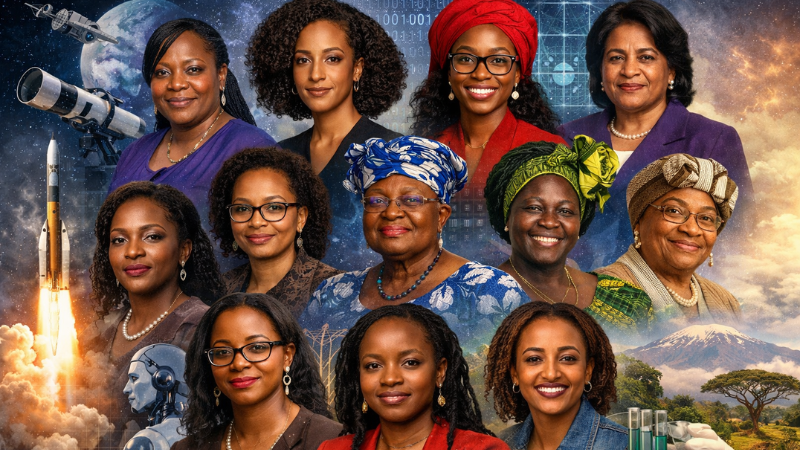
As Women’s History Month comes to a close, it is worth reflecting on the fact that some of the most important breakthroughs in science, technology, and innovation today are being shaped by African women—often outside the spotlight but at the very centre of global progress.
From space science to artificial intelligence ethics, these women are not just participating in the future of technology—they are actively shaping its direction.
1. Maggie Aderin-Pocock — Space Scientist Making the Universe Accessible
A British-Nigerian space scientist, Maggie has contributed to major space instrumentation projects and is one of the most recognisable voices in space science communication. She has worked on satellite systems used in space exploration and has helped bring astronomy to global audiences.
While not a NASA leader, she represents African excellence in the global space science ecosystem.
2. Timnit Gebru — One of the Most Influential Voices in AI Ethics
Born in Ethiopia, Timnit Gebru is one of the most important figures in modern artificial intelligence ethics. She co-led Google’s Ethical AI team and has been a global advocate for fairness, accountability, and transparency in AI systems.
Her research fundamentally challenged how large AI models are trained and evaluated, especially around bias and data ethics—making her one of the most influential critics shaping responsible AI development.
3. Joy Buolamwini — The “Coded Bias” Pioneer
A Ghanaian-American computer scientist and founder of the Algorithmic Justice League, Joy Buolamwini, exposed racial and gender bias in facial recognition systems. Her work directly influenced global tech companies and policymakers to rethink AI fairness.
Her documentary Coded Bias sparked worldwide conversations on ethical AI development.
4. Ifeoma Ajunwa — AI, Law, and Workplace Technology Scholar
A Nigerian-born academic, Ifeoma Ajunwa, studies the intersection of AI, labour, surveillance, and civil rights. Her work is shaping global policy discussions on how AI is used in hiring systems, workplace monitoring, and algorithmic decision-making.
5. Rebecca Enonchong — Africa’s Tech Ecosystem Builder
A Cameroonian tech entrepreneur and advocate, Rebecca Enonchong, has been instrumental in building and supporting Africa’s startup ecosystem. She has spent decades championing digital innovation and supporting tech founders across the continent.
6. Juliana Rotich — Digital Innovation Pioneer
Co-founder of Ushahidi, Juliana Rotich, helped create one of the world’s most influential crisis-mapping platforms. Her work transformed how data is used in humanitarian response, civic technology, and real-time crisis reporting globally.
7. Temie Giwa-Tubosun — Health Tech Innovator Saving Lives
Founder of LifeBank, Temie Giwa-Tubosun, is revolutionising healthcare logistics by using technology to ensure hospitals across Africa receive critical blood and medical supplies in real time.
Her innovation is a powerful example of how tech can directly save lives.
8. Bethlehem Tilahun Alemu — Africa’s Global Entrepreneurship Story
Founder of soleRebels, Bethlehem Tilahun Alemu, built one of Africa’s most globally recognised ethical footwear brands. Her work has proven that African creativity and enterprise can scale globally while staying deeply rooted in local identity.
9. Ngozi Okonjo-Iweala — Global Trade Trailblazer
As the first African and first woman to lead the World Trade Organization, Ngozi Okonjo-Iweala continues to shape global economic systems and trade policy at the highest level.
10. Wangari Maathai — Environmental Justice Pioneer
Kenya’s Wangari Maathai became the first African woman to win the Nobel Peace Prize. Through the Green Belt Movement, she connected environmental conservation with women’s empowerment, leaving a legacy that continues to shape climate action globally.
11. Ellen Johnson Sirleaf — Africa’s First Elected Female President
Ellen Johnson Sirleaf made history as Africa’s first elected female head of state, leading Liberia through recovery and reform. Her leadership remains a global benchmark for governance and resilience.
12. Ameenah Gurib-Fakim — Scientist and Former Head of State
A biodiversity scientist turned president of Mauritius, Ameenah Gurib-Fakim, brought scientific thinking into national leadership, bridging the gap between research, innovation, and governance.
Beyond the List: Africa Is Already Building the Future
While global institutions like NASA and the AI industry have yet to see African women at their very top leadership levels, the reality is clear: African women are already shaping the foundations of these fields.
From defining AI ethics to advancing space science communication, from building tech ecosystems to leading nations, they are not waiting to be included in the future of innovation—they are actively designing it.
