


For the first time in over 50 years, humanity is preparing to send astronauts beyond low-Earth orbit, retracing a path once forged during the Apollo program but with a new purpose, new technology, and a long-term vision for deep space exploration.
The Artemis II mission will last approximately 10 days in space, marking a critical test flight of NASA’s deep space exploration systems before future lunar surface missions.
The crew aboard Orion includes NASA astronauts Reid Wiseman, Victor Glover, Christina Koch, and Canadian Space Agency astronaut Jeremy Hansen.
At the heart of this mission is Artemis II, and while its journey to the Moon is historic, it is the return—the splashdown of the Orion spacecraft—that ultimately defines its success.
The journey home begins long before the capsule ever touches water. After completing its path around the Moon, Orion sets its course back to Earth with extraordinary precision, aligning itself with a narrow re-entry corridor that will determine the success or failure of the entire mission. Too steep, and the spacecraft risks destructive forces. Too shallow, and it could skip off the atmosphere and drift back into space. Everything must be exact.
As Orion approaches Earth, it carries immense energy, travelling at nearly 39,000 km/h—far faster than spacecraft returning from low-Earth orbit. What follows is not simply a descent, but a controlled collision with the atmosphere. The air ahead of the capsule compresses violently, heating to temperatures of up to 2,800°C and forming a glowing plasma sheath around the spacecraft. For a brief moment, Orion becomes a streak of fire across the sky.
Inside, the astronauts rely on one of the most critical pieces of engineering ever built—the heat shield. Designed to endure and dissipate extreme temperatures, it gradually burns away, carrying heat with it and ensuring the interior of the spacecraft remains habitable. At the same time, Orion’s guidance systems work continuously to maintain the correct orientation, distributing heat and controlling its trajectory through this volatile environment.
Digital Dollars, Real Impact: How Stablecoins Are Reshaping Africa’s Financial Future
Then comes one of the most defining and widely anticipated moments of the entire splashdown sequence—the six-minute communications blackout.
As the plasma thickens around the spacecraft, it interferes with radio signals, cutting off direct communication with NASA. For approximately six minutes, there is silence. No telemetry. No voice contact. No confirmation from the crew. Mission control can only wait, relying entirely on the engineering and autonomy of the spacecraft.
Within the capsule, however, everything continues as planned. Orion navigates, stabilizes, and protects its crew without real-time input from Earth. The systems guiding its descent, the heat shield absorbing the intense thermal load, and the structural integrity of the spacecraft are all put to the ultimate test. While such blackouts were also experienced during the Apollo era, this moment in Artemis II represents a critical validation of modern deep space return capabilities.
And then, as Orion descends further and the plasma begins to dissipate, communication is restored. It is a brief moment, but one that signals that the most intense phase of re-entry has been successfully completed.
Rather than plunging directly toward Earth, Orion employs a skip re-entry technique—an advancement over earlier missions such as Apollo 17. The spacecraft dips into the atmosphere, generates lift, and rises again before committing to its final descent. This maneuver reduces the strain on the crew, spreads heat more evenly across the heat shield, and allows for far greater control over the landing zone. It is not just a fall—it is a guided return.
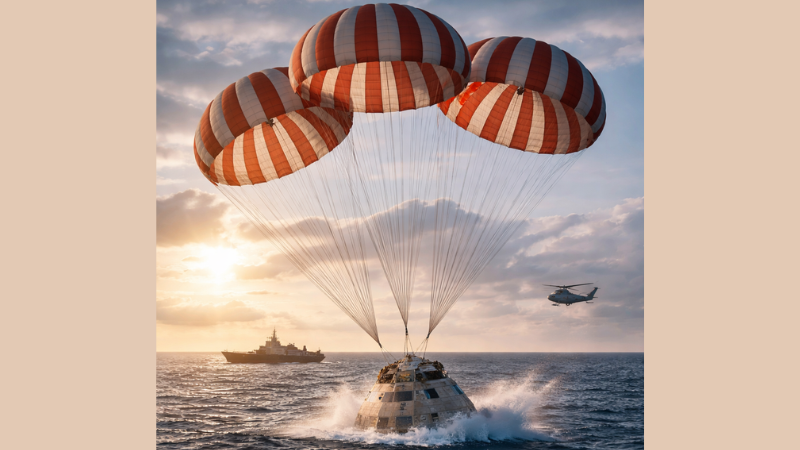
As the Artemis II spacecraft slows and descends into denser layers of the atmosphere, the next phase begins: parachute deployment. This is one of the most delicate and critical parts of the entire sequence. First, small drogue parachutes deploy, stabilizing the capsule and reducing its speed. These are followed by pilot parachutes, which prepare the system for full deployment. Finally, three massive main parachutes unfurl above Orion, transforming its rapid descent into a controlled and steady glide.
These parachutes are among the largest ever used in human spaceflight, engineered to withstand immense forces while ensuring a safe landing speed. Suspended beneath them, the capsule drifts toward Earth, the violence of re-entry giving way to a moment of near stillness.
Below, the Pacific Ocean stretches out as the final destination.
The Artemis II splashdown itself is both simple and profound. Orion meets the water at a carefully calculated angle and speed, with the ocean acting as a natural cushion to absorb the remaining energy of descent. At 7:07 p.m. Pacific Time, the capsule completes its return to Earth.
For a brief moment, Orion may rock with the motion of the waves before stabilizing, supported by the onboard flotation systems that keep it upright and secure.
After the intensity of re-entry, the image is almost serene—a spacecraft floating in open water, having just completed a journey from deep space.
Recovery Operations: Bringing the Artemis II Crew Home
But even here, the Artemis II mission is not yet complete.
Recovery operations begin almost immediately, led by NASA in partnership with the United States Navy. Positioned in advance, recovery teams move swiftly toward the capsule. Divers are the first to arrive, securing the spacecraft and attaching a flotation collar to enhance stability in the ocean.
Helicopters hover overhead, ready to assist with crew extraction, while recovery ships close in to retrieve both astronauts and capsule. Inside Orion, the crew awaits the opening of the hatch—their transition from the isolation of space back to Earth.
Astronauts are carefully extracted and undergo immediate medical checks, ensuring they are in good condition after the physical stresses of re-entry and the effects of microgravity.
This includes the critical re-entry phase, during which the six-minute communications blackout temporarily cut the crew off from Mission Control as plasma interference blocked all radio signals.
The capsule itself is then lifted from the water and transported for detailed analysis, its data offering critical insights for future missions.
This final phase—often overlooked—is as important as the splashdown itself. It completes the cycle of exploration, ensuring not just a successful landing, but a safe and controlled return to Earth.
In the end, the splashdown of Artemis II is more than a technical achievement. It is the moment where everything comes together—from the violence of atmospheric re-entry to the calm of ocean waters, from six minutes of silence to the reassurance of restored communication, from deep space isolation to human recovery
