


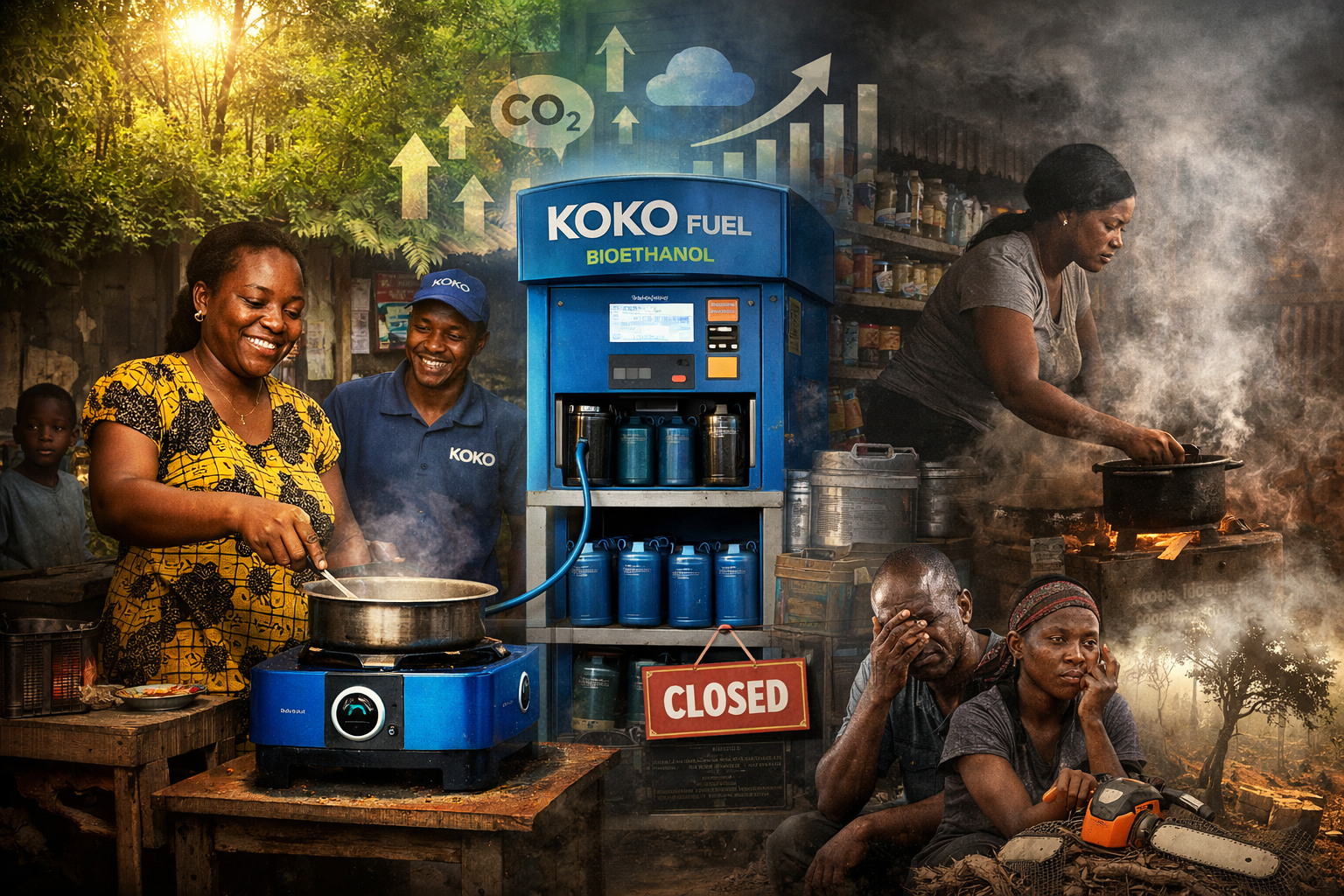
For over a decade, KOKO Networks represented one of Kenya’s boldest attempts to merge technology, social impact, and climate action.
Founded in 2013 by entrepreneur Greg Murray, KOKO’s mission was deceptively simple: provide millions of households with an affordable, clean alternative to charcoal and kerosene. I
n a country where indoor air pollution causes thousands of respiratory illnesses each year and deforestation remains a growing threat, the stakes were high.
KOKO introduced bioethanol fuel, distributed via a network of smart dispensers installed in local shops, and paired it with digitally-enabled cookstoves designed for efficiency and safety. What set KOKO apart was its ability to combine convenience with social purpose: households could refill fuel as easily as topping up mobile credit, while simultaneously reducing health risks and carbon emissions.
By mid-2025, KOKO had reportedly reached over 1.3 million households, transforming kitchens across Nairobi and peri-urban areas. Families embraced the cleaner, cheaper fuel, while small shop owners and local agents earned income through distribution.
Beyond convenience, KOKO offered a tangible sense of empowerment: women could cook without choking smoke, families could save on fuel costs, and households could participate in a climate solution that had real, measurable impact. The company became a symbol of how African innovation could address local problems while aligning with global climate goals.
The financial model underpinning this innovation was as bold as the vision itself. KOKO subsidized fuel prices far below market rates, making clean cooking affordable for low-income families. This subsidy was supported primarily through carbon credits, which monetized the reduction in emissions achieved by replacing charcoal with bioethanol.
The credits were sold in international markets, providing the financial leverage needed to sustain the operation. With backing from institutions including the Microsoft Climate Innovation Fund, South African banks, and guarantees from the World Bank’s Multilateral Investment Guarantee Agency, KOKO seemed poised to scale rapidly and sustainably.
Collapse at the Crossroads: Policy, Carbon Markets, and the Sudden End in Kenya
Yet, despite its apparent success and global recognition, KOKO Networks faced a challenge that ultimately proved insurmountable: regulatory uncertainty. For months, the company awaited the Letter of Authorisation from Kenyan authorities, a requirement to sell carbon credits internationally.
This approval would have unlocked the financial engine that subsidized fuel costs and kept the business viable. When the government withheld the authorization—citing concerns over market dominance and allocation fairness—KOKO’s revenue model was destabilized.
Mass Exits in Africa: A Crisis or a Catalyst for Reinvention?
The consequences were swift and jarring. In late January 2026, the company sent terse text messages to customers announcing an immediate halt to operations. Dispensers went dark, fuel balances became inaccessible, and families who had relied on clean ethanol faced a sudden return to kerosene and charcoal. The social and environmental impact was immediate: indoor air pollution returned to homes, families confronted higher fuel costs, and forests were once again under pressure. Over 700 direct employees lost their jobs overnight, and thousands of indirect agents and small shop owners were left without income. The abrupt closure highlighted a harsh reality for many African startups: even those with transformative impact remain fragile when external dependencies, such as policy approval or international financing, fail.
This collapse also underscores a broader challenge in African innovation. Climate-focused ventures often operate at the intersection of social impact and financial return, but they rely heavily on mechanisms outside their control, including carbon markets and regulatory frameworks.
KOKO’s experience exposes the tension between ambition and structural fragility, and it forces investors, entrepreneurs, and policymakers alike to confront uncomfortable questions: How can we design climate tech ventures that are both impactful and resilient? How can governments support innovation without compromising oversight? And how can African startups navigate global markets while remaining grounded in local realities?
Lessons for African Innovation: Sustainability, Startups, and the Road Ahead
KOKO Networks’ rise and fall offer several crucial lessons for African innovation. First, impact alone is not enough. While millions of households experienced cleaner cooking, lower fuel costs, and improved health outcomes, these benefits proved vulnerable to financial and regulatory shocks. Startups must build models that are resilient to policy shifts and external dependencies, ensuring that the mission can withstand unforeseen obstacles.
Second, the story highlights the importance of government-private sector alignment. Startups tackling climate and social challenges often operate in nascent regulatory landscapes. Clear, predictable policies are essential if entrepreneurs are to innovate confidently. Without alignment and transparency, even the most promising ventures risk collapse, leaving communities and investors exposed.
Finally, KOKO demonstrates the enormous potential and fragility of African startups. The continent is a fertile ground for innovations that blend technology, social good, and climate action, but these ventures require patient capital, flexible financing mechanisms, and supportive ecosystems to thrive. KOKO’s vision lives on in the conversations it sparked about clean cooking, climate action, and sustainable business in Africa. Its legacy is both a testament to the possibilities of African ingenuity and a cautionary tale about the delicate balance between ambition, impact, and sustainability.
While the company’s abrupt closure was a setback, the story of KOKO Networks will not be forgotten. It is a vivid reminder that scaling solutions in Africa requires more than technology—it demands careful integration of finance, policy, and community, and a recognition that lasting impact is inseparable from sustainable design. The kitchens of millions may now face smoky setbacks, but the blueprint KOKO built can inform a future where clean, affordable, and climate-conscious solutions are not just possible, but enduring.
