


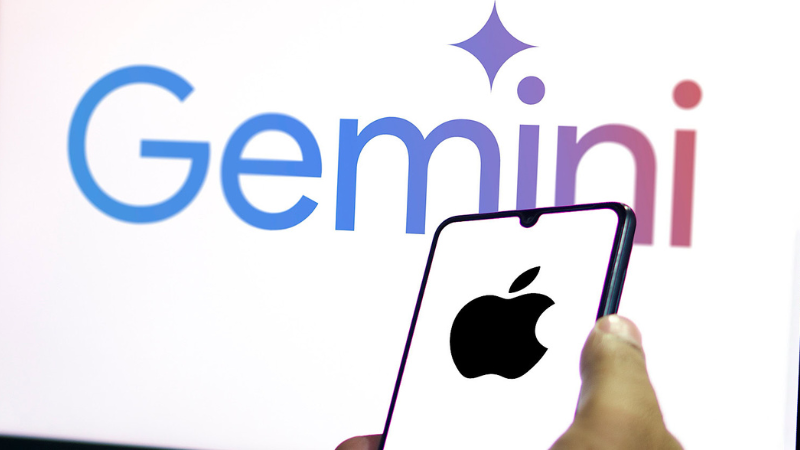
In an industry defined by rivalry, Apple and Google’s newly announced collaboration is striking not just for its scale, but for what it represents in the evolving artificial intelligence (AI) landscape.
Under a multi-year agreement, Apple has confirmed that the next generation of its Apple Foundation Models will be built on Google’s Gemini AI models and cloud technology. These models will help power upcoming Apple Intelligence features, including a more personalised version of Siri expected later this year. While Apple Intelligence will continue to run on-device and through Apple’s Private Cloud Compute, the foundational AI capability beneath it will rely on Google’s technology.
At first glance, this may seem like a straightforward technical partnership. In reality, it marks a significant shift in how even the most powerful tech companies approach AI — and it raises important questions about power, trust, privacy, and the future of global digital infrastructure.
Why This Partnership Matters
For years, Apple and Google have represented two different philosophies in technology. Apple has built its brand on tightly controlled ecosystems, privacy-first messaging, and vertical integration. Google, by contrast, has dominated through scale, data, and open access to AI research and cloud infrastructure.
Apple’s decision to base its Foundation Models on Google’s Gemini signals a key reality of the AI era: no single company can do everything alone. Developing large-scale, competitive AI models requires massive computational resources, deep research capabilities, and constant iteration. Even Apple — one of the world’s most valuable companies, has acknowledged that Google currently offers the “most capable foundation” for its AI ambitions.
This is not a surrender of control, but a strategic alignment. Apple remains firm on where intelligence runs — on-device and within its Private Cloud Compute, while outsourcing the underlying model capability. The message is clear: the future of AI is collaborative, layered, and interdependent, even among competitors.
A New Phase of AI Competition
This partnership also signals a maturing AI market. Early AI competition was about who could build the biggest model or launch the flashiest chatbot. The next phase is about integration, reliability, and trust.
Apple Intelligence is not positioned as a standalone product but as an invisible layer embedded across everyday experiences from voice assistants to productivity tools. For this to work, AI must be dependable, efficient, and respectful of user privacy. Apple’s emphasis on on-device processing and Private Cloud Compute suggests a future where AI becomes ambient, present but not intrusive.
By choosing Gemini as its foundation, Apple is betting on Google’s ability to deliver cutting-edge AI while allowing Apple to maintain its strict privacy standards. This balance will be closely watched by regulators, consumers, and competitors alike.
Privacy as a Differentiator — Not an Afterthought
One of the most notable aspects of the announcement is Apple’s reaffirmation of its privacy stance. Apple Intelligence will continue to operate under what it describes as “industry-leading privacy standards,” even while leveraging Google’s AI models.
This raises an important point: in the next wave of AI adoption, privacy will become a competitive advantage, not just a compliance requirement. As AI systems become more personalised, learning from user behaviour, preferences, and context, trust will be central to adoption.
For users globally, this partnership could set a precedent for how powerful AI can coexist with privacy protections. For governments and regulators, it offers a test case in balancing innovation with accountability.
What This Means for the Global South
While the announcement focuses on Apple users, its implications extend far beyond Silicon Valley. AI infrastructure decisions made by global tech giants shape access, affordability, and digital inclusion worldwide.
Also Read: Mass Exits in Africa: A Crisis or a Catalyst for Reinvention?
For Africa and other emerging markets, this partnership highlights a growing concentration of AI power among a few global players. Foundation models, cloud infrastructure, and AI standards are increasingly controlled by companies based in the Global North. This raises questions about whose data trains these models, whose languages are prioritised, and whose realities are reflected.
At the same time, collaborations like this could accelerate the rollout of more capable, energy-efficient AI tools on consumer devices — potentially lowering barriers to access in regions with limited connectivity.
The challenge for African policymakers, innovators, and researchers is to ensure that this next phase of AI does not deepen dependency, but instead creates space for local innovation, regulation, and capacity-building.
Beyond Competition: A Signal of What’s Next
The Apple–Google collaboration is not just about Siri or Gemini. It is a signal that the AI era will be defined less by isolated dominance and more by strategic partnerships, shared infrastructure, and negotiated trust.
As AI becomes embedded in daily life, the most important questions will not be who built the model, but who controls it, who benefits from it, and who is protected by it.
This partnership reminds us that the future of AI is not only technical — it is political, economic, and deeply human.
And as the technology becomes more personal, the responsibility to get it right becomes collective.
