


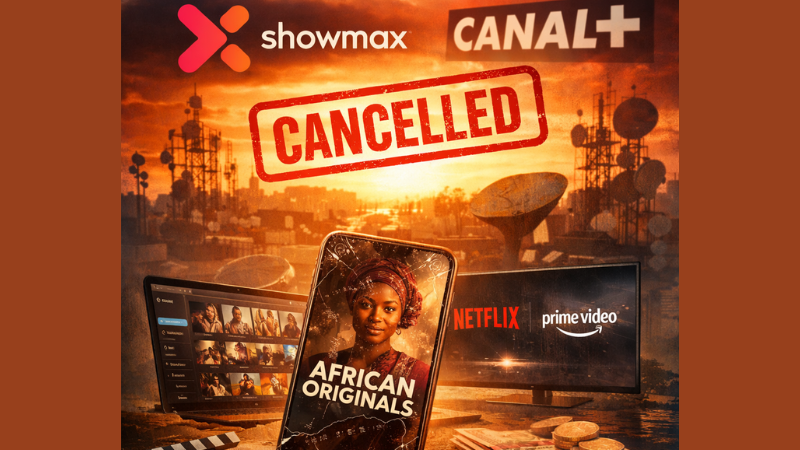
The decision by Canal+ to shut down Showmax marks the end of one of Africa’s most ambitious attempts to build a homegrown streaming platform capable of competing with global players. The announcement, which follows Canal+’s acquisition of MultiChoice, signals not just the closure of a service that has operated for over a decade, but a broader shift in the economics and future direction of the streaming industry across Africa.
When Showmax launched in 2015, the global streaming market was still in its growth phase. Platforms like Netflix were rapidly expanding beyond North America and Europe, while audiences around the world were beginning to shift away from traditional broadcast television toward on-demand viewing. For MultiChoice, Showmax represented both a defensive and strategic play: a way to maintain relevance in a rapidly changing media landscape while also building a streaming service tailored specifically for African audiences.
From the beginning, Showmax sought to differentiate itself through a strong emphasis on local storytelling. While international platforms brought global blockbusters and widely syndicated series to African viewers, Showmax invested in African originals—producing and distributing content from South Africa, Nigeria, Kenya, and other markets across the continent. This strategy helped the platform carve out a distinct identity. It positioned itself not merely as another streaming service, but as a home for African narratives that often struggled to find distribution on global platforms.
Over time, the platform became an important player in the continent’s growing digital entertainment ecosystem. It created new opportunities for African filmmakers, actors, writers, and production houses while also exposing local audiences to a wider variety of regional stories. In many ways, Showmax helped catalyze the rise of African streaming content at a time when the global industry was only beginning to recognise the potential of the continent’s creative economy.
Yet building a streaming platform is one of the most capital-intensive undertakings in modern media. Success requires not only compelling content but also significant investment in technology, infrastructure, and marketing. The cost of licensing global content libraries, producing original series, maintaining high-performance streaming infrastructure, and acquiring subscribers has grown exponentially over the past decade.
For companies like Netflix, these costs are spread across a massive global subscriber base that exceeds hundreds of millions of users. This scale allows the company to invest billions of dollars annually in original programming while maintaining competitive subscription prices across different markets. The platform’s global reach also allows it to distribute the same content across multiple territories, dramatically improving the return on each production investment.
Showmax, by contrast, operated largely within the African market. While it expanded into multiple countries, its subscriber base remained significantly smaller than that of its global competitors. This meant that the costs of producing and licensing content were distributed across a far smaller pool of subscribers, making profitability much harder to achieve.
The challenge became even more pronounced as global streaming platforms accelerated their investment in African markets. Netflix began commissioning African originals and expanding its catalogue of regional content, while services like Amazon Prime Video and Disney+ continued to grow their international footprints. These companies entered the African market with enormous production budgets, vast content libraries, and highly sophisticated technology platforms developed over years of operating at global scale.
Mass Exits in Africa: A Crisis or a Catalyst for Reinvention?
For African audiences, this competition created more choice than ever before. But for regional streaming platforms, it significantly raised the bar.
Beyond competition, the African market itself presents unique structural challenges for streaming businesses. Broadband infrastructure, while improving, remains uneven in many countries. Mobile data costs can still be relatively high compared to average income levels, limiting how frequently some consumers can stream high-definition video. In addition, subscription-based digital services must contend with lower price points in many markets, reducing the potential revenue per user.
These realities mean that streaming platforms operating in Africa often face a slower path to profitability than their counterparts in more developed markets.
Against this backdrop, Canal+’s acquisition of MultiChoice triggered a comprehensive review of the company’s digital strategy. The French media giant has long been expanding its footprint across Africa, particularly in Francophone markets, and the acquisition positioned it as one of the largest media players on the continent. As part of the integration process, executives evaluated the sustainability of existing services within the MultiChoice ecosystem, including Showmax.
The conclusion appears to have been that maintaining Showmax as a standalone streaming platform was not economically viable in the long term. The service reportedly incurred substantial annual losses, reflecting the immense costs associated with operating a competitive streaming business.
The decision to shut down Showmax therefore reflects a broader global trend. Across the media industry, companies are moving away from the early “growth at all costs” era of streaming toward a more disciplined focus on profitability and consolidation. Several media companies have already merged or restructured their streaming services in order to reduce duplication and streamline operations.
In Africa, this could signal the emergence of a different model for digital entertainment distribution. Rather than relying solely on standalone streaming platforms, media companies may increasingly pursue hybrid strategies that combine traditional broadcasting with digital streaming. MultiChoice, for example, still commands a substantial subscriber base through its satellite television services, which could serve as a foundation for integrating streaming features into broader entertainment packages.
At the same time, the closure of Showmax raises important questions about the future of African content production. The platform played a significant role in commissioning local series and films, helping to build an ecosystem of African storytellers and production companies. Its investment in regional content contributed to the growing visibility of African narratives in the global entertainment industry.
The key question now is whether that investment will continue through other channels within the Canal+ ecosystem. Given the company’s existing presence across African media markets, many industry observers expect that African storytelling will remain a priority, though possibly distributed through different platforms or partnerships.
Ultimately, the end of Showmax represents both the conclusion of an important chapter and the beginning of a new phase for Africa’s streaming industry. For more than ten years, the platform demonstrated that African audiences were ready for digital entertainment services built around their own stories and cultural experiences.
While the economics of the streaming wars have proven unforgiving, the demand for African content continues to grow both within the continent and globally. In that sense, the legacy of Showmax may extend far beyond the lifespan of the platform itself. It helped prove that Africa’s creative industries have the talent, the stories, and the audience needed to participate in the global streaming era—even as the business models behind that era continue to evolve.
